.svg)


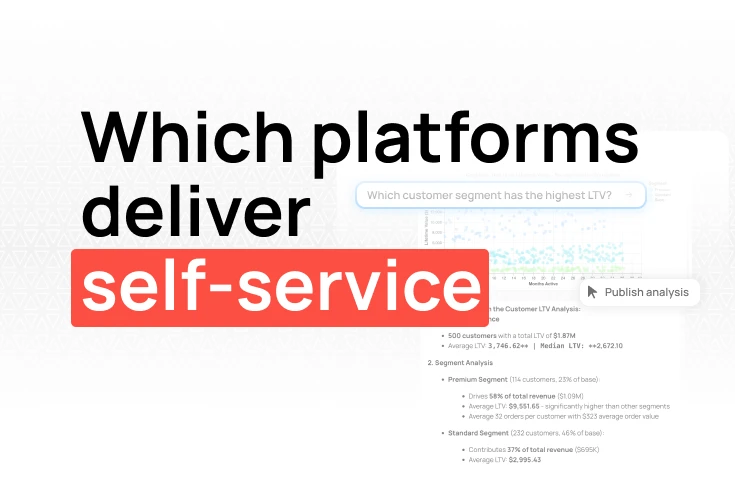
AI BI tools comparison: which platforms actually deliver self-service?

TL;DR: Omni is a modern BI platform with a thoughtful semantic layer approach — sitting between Looker (heavy governance) and Sigma (spreadsheet-first). But it's still a relatively new product, has limited AI features, no Python support, and undisclosed pricing. Fabi is the strongest alternative for teams that want AI-powered analytics without heavy governance overhead. Looker is the right choice if LookML-level governance is genuinely required. Sigma serves business users who want spreadsheet-style exploration. Metabase and Apache Superset cover the open-source angle.
Omni Analytics emerged to address a real gap: teams that find Looker too heavy and complex but want more structure than Sigma or Metabase provide. Its workbook-style interface lets business users explore data through a spreadsheet-like model, while data teams can define a semantic layer that ensures consistent metric definitions.
The positioning is credible. Looker's LookML is powerful but requires significant data engineering investment and a long implementation timeline. Sigma is more accessible but offers limited governance. Omni aims to sit in between: governed enough for data teams to trust, accessible enough for business users to navigate independently.
But Omni is still a relatively young product. The ecosystem is smaller than established competitors. AI and natural language querying capabilities are limited. Python support is absent. And pricing requires a sales conversation, which makes it hard to evaluate quickly.
AI-powered querying. Omni's AI capabilities are limited compared to newer AI-native platforms. If enabling non-technical users to ask questions in plain English is a core requirement, look for tools that genuinely invest in this capability.
Python and code support. Omni doesn't support Python. Analysts who need to write custom code, run statistical models, or use Python visualization libraries will need a separate tool.
Transparent pricing. Omni requires a sales conversation to get pricing. For teams evaluating multiple tools simultaneously, this is a friction point compared to platforms with public pricing.
Established product depth. As a newer product, Omni has a smaller ecosystem, fewer integrations, and less production history than established alternatives. Teams with complex requirements may find edge cases that aren't handled yet.
Flexibility on governance model. Not every team needs a full semantic layer. Some need AI assistance, some need code flexibility, some need open-source options. A good alternative fits what you actually need rather than what Omni is designed for.
Omni adds a structured semantic layer on top of a BI interface. Fabi takes a different approach: replace the interface entirely. Describe what you want in plain English, and Fabi generates a complete, shareable dashboard. No semantic layer to build, no interface to learn, no SQL to write.
Pros:
Cons:
What makes it stand out:
Omni's value proposition is governance: a structured layer that ensures consistent metric definitions across the organization. That's a real problem at scale. But for most teams, the more immediate problem is that the operators who need data the most, product managers, GTM leads, founders, RevOps managers, still can't get answers without a data team in the loop.
Fabi solves this with a new paradigm. Instead of asking non-technical users to navigate a BI interface, even a well-designed one, Fabi lets them describe the dashboard they need. A growth manager describes their acquisition funnel. A founder asks for weekly MRR by cohort. A sales ops lead wants pipeline velocity by rep. Fabi generates the complete dashboard, fully labeled, ready to share or schedule.
Hundreds of native connectors mean your warehouse, CRM, payment processor, and product analytics tools all connect without custom pipelines. The direct Slack integration means insights land in the channel where decisions get made, not in a tool someone has to log into.
Aisle reduced data analysis time by 92% after switching to Fabi. Their data team handles ad hoc requests in hours instead of weeks.
Best for: Product teams, GTM teams, founders, and operators who need data without a governance investment or a data team in the loop.
Pricing: Free tier available, then $39/month per builder.
If metric governance is why you're evaluating Omni, ensuring consistent definitions across the organization, Looker's LookML model is the most mature and rigorous implementation of this approach.
Pros:
Cons:
What makes it stand out:
Omni was partly designed as a lighter alternative to Looker. If you're evaluating both, the core question is whether you need Looker's full rigor (and can invest in LookML expertise) or whether a lighter semantic layer approach (Omni, or skipping governance entirely with Fabi or Sigma) is sufficient.
Best for: Enterprise data teams with strict governance requirements, dedicated data engineering, and appropriate budgets.
Pricing: Contact for pricing (typically $50K+/year).
Sigma takes a different approach to self-service than Omni: a spreadsheet interface rather than a semantic layer. Business users explore data through filter, sort, and pivot operations that mirror Excel.
Pros:
Cons:
What makes it stand out:
Where Omni adds a semantic layer to structured exploration, Sigma eliminates the learning curve by using a familiar spreadsheet model. If your business users already know Excel or Google Sheets, the transition to Sigma is minimal. The trade-off is less governance rigor.
Best for: Business teams that want warehouse-native performance with familiar spreadsheet interaction.
Pricing: Contact for pricing.
For teams that don't need a semantic layer and want the simplest, most accessible path to dashboards and basic self-service, Metabase is the most popular open-source option.
Pros:
Cons:
What makes it stand out:
Metabase is designed to minimize friction. Non-technical users can answer basic data questions without SQL knowledge, dashboards are easy to build and share, and the open-source version costs nothing to run. It's the starting point for many teams before data complexity demands more.
Best for: Small to mid-sized teams that want accessible dashboards without governance overhead.
Pricing: Free (self-hosted), cloud from $85/month.
For engineering-heavy teams that want full control and deeper SQL capabilities than Metabase, Superset is the more powerful open-source option.
Pros:
Cons:
What makes it stand out:
Superset gives engineering teams everything Metabase does and more, deeper SQL exploration, more chart types, and the ability to customize nearly anything. The trade-off is more infrastructure complexity.
Best for: Engineering teams that want maximum open-source flexibility and have the resources to manage deployment.
Pricing: Free (self-hosted), Preset from ~$20/user/month.
Lightdash is open-source BI built specifically for dbt teams, reading directly from dbt models to expose them as a self-service analytics layer. For teams with dbt in their stack, it provides semantic layer benefits similar to Omni without the commercial pricing.
Pros:
Cons:
What makes it stand out:
If your team already uses dbt, Lightdash is the most natural fit for a Omni alternative, you get similar semantic layer benefits by building on top of your existing dbt project, without a commercial pricing commitment.
Best for: Engineering and data teams already using dbt who want self-service analytics without building a separate metric layer.
Pricing: Self-hosted free, cloud plans from $400/month.
AI-powered analytics without a governance layer investment: Fabi. Natural language querying, Python notebooks, automated workflows, and transparent pricing. Works from day one without building a semantic model.
Enterprise governance at scale: Looker. LookML is the most mature and rigorous semantic layer approach. Appropriate for large organizations where metric consistency is a strategic priority and budget is available.
Business users who want spreadsheet-style exploration: Sigma. Familiar interface, live warehouse connections. If your team knows Excel, they'll adapt quickly.
Simple, accessible dashboards with no cost: Metabase (self-hosted). The easiest open-source path to dashboards and basic self-service.
Engineering teams that want open-source depth: Apache Superset. More SQL power than Metabase, full infrastructure control.
dbt teams that want dbt-native self-service: Lightdash. Your metric layer is already built, Lightdash exposes it without additional modeling work.
What is Omni Analytics?
Omni is a business intelligence platform that combines spreadsheet-style exploration with a governed semantic layer. It's designed for data teams that find Looker too complex and expensive but want more structure than tools like Sigma or Metabase provide. Omni lets business users explore data through a workbook interface while data teams define metrics and dimensions that ensure consistent definitions.
How much does Omni Analytics cost?
Omni doesn't publish pricing publicly. You'll need to contact their sales team for a quote. This makes it harder to evaluate Omni quickly against alternatives with transparent pricing, like Fabi ($39/month per builder) or Power BI ($14/user/month).
Does Omni support Python?
No. Omni doesn't have a Python environment. Analysts who need to write custom code, run statistical models, or use Python libraries for visualization will need a separate tool. If Python support is a requirement, Fabi or Hex are better alternatives.
Is Omni a good alternative to Looker?
For teams that find Looker too expensive or complex to implement, Omni can be a viable middle ground. It provides semantic layer governance without requiring LookML expertise. The trade-off is that Omni is newer with a smaller ecosystem and less production history. For organizations where governance is the top priority and budget is available, Looker remains the more mature option.
What is the difference between Omni and Sigma?
Both Omni and Sigma are warehouse-native BI tools that target business users, but they take different approaches. Sigma uses a pure spreadsheet interface with no governance layer, users explore data through Excel-style operations. Omni adds a semantic layer that data teams define to ensure consistent metric definitions. Sigma is more accessible out of the box; Omni provides more governance. Neither has strong AI capabilities or Python support.
Is there a free Omni alternative?
Yes. Metabase is free to self-host and covers standard dashboard and self-service use cases. Apache Superset is open source and free to run with more technical depth. Lightdash is free to self-host for dbt teams. Fabi has a free tier that includes AI-powered querying.